
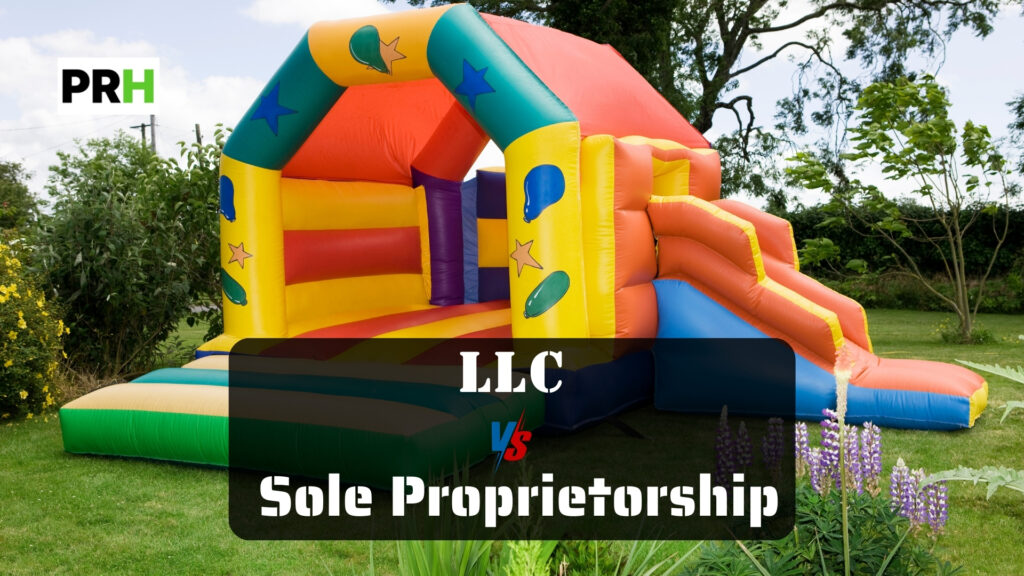

For bounce house and party rental operators, forming an LLC is not optional—it’s essential protection. The inflatable rental industry presents uniquely elevated liability risks: over 18,000 bounce house injuries occur annually in the U.S., and wind-related incidents have caused 479 injuries and 28 deaths worldwide since 2000. A single serious accident can expose sole proprietors to lawsuits ranging from $100,000 to well over $1 million in wrongful death cases, putting personal homes, vehicles, and savings directly at risk. While sole proprietorships require minimal paperwork, the liability exposure in this industry makes them a dangerous choice. The modest cost of LLC formation—typically $50-$300 in state filing fees—is negligible compared to the financial devastation a lawsuit can cause.
Why inflatable rentals carry exceptional liability risk
The bounce house rental business operates in one of the highest-liability segments of the party and event industry. Unlike renting tables or linens, inflatables combine physical activity, child participants, and weather-dependent equipment that can become dangerous in seconds.
Research from the University of Georgia documented 132 wind-related incidents between 2000 and 2021, finding that one-third occurred at wind speeds below 20 mph—conditions most operators would consider safe. Bounce houses weigh just 100-300 pounds but act like hot air balloons when inflated, making them susceptible to sudden gusts. The Consumer Product Safety Commission reports approximately 31 children are treated daily for bounce house injuries, with fractures comprising 25.8% of cases and head and neck injuries accounting for roughly 20%.
This isn’t theoretical risk. In March 2016, seven-year-old Summer Grant died at an Easter fair in England when a bounce castle blew 300 meters down a hill. The operators—William and Shelby Thurston, who ran a family business operating “for generations”—were convicted of manslaughter by gross negligence and sentenced to three years imprisonment. In 2019, nine-year-old Elizabeth Hammond died in Reno, Nevada when a bounce house flew into power lines, resulting in a wrongful death lawsuit against the rental company owner. A 2019 Minnesota case saw a seven-figure jury verdict against a church after an unanchored bounce house struck a 76-year-old woman, causing a traumatic brain injury—the defense’s “Act of God” argument was rejected.
These cases demonstrate that courts hold operators to strict standards. Even well-intentioned business owners face severe consequences when equipment causes injury.
The fundamental difference: personal asset protection
The core distinction between sole proprietorships and LLCs comes down to what happens when something goes wrong. A sole proprietor is personally liable for every business debt and legal judgment. There is no separation between owner and business—creditors can pursue personal bank accounts, retirement savings, vehicles, and real estate to satisfy a judgment.
An LLC creates a legal barrier between business and personal assets. When properly maintained, the business’s liabilities remain with the business. A lawsuit against your rental company cannot automatically reach your family’s home or college savings. This protection exists specifically because the LLC is recognized as a separate legal entity.
The protection, however, is not absolute. Courts can “pierce the corporate veil” and hold owners personally liable if the LLC is treated as a personal extension rather than a genuine business entity. The most common triggers include commingling business and personal funds, failing to maintain adequate business capitalization, and ignoring basic corporate formalities like operating agreements. One Ohio case study illustrates the risk: when litigation revealed that an LLC owner had used business funds for personal lunches and other non-business expenses, the court pierced the veil and held the owner personally liable.
For bounce house operators, this means LLC formation is only the first step. Maintaining a separate business bank account, documenting major decisions, and keeping business finances completely separate from personal spending are ongoing requirements for the protection to hold.

Formation costs and ongoing requirements by state
LLC formation costs vary significantly by state, but remain modest for most operators. Kentucky and Montana offer the lowest filing fees at $40 and $35 respectively, while Massachusetts charges $500—the highest in the country. The national average sits around $132 for initial formation.
More significant are ongoing annual costs. Several states—Arizona, Missouri, New Mexico, Ohio, and South Carolina—require no annual fees or reports for LLCs. Others impose substantial recurring costs: California charges an $800 annual franchise tax regardless of business income, Tennessee and Delaware each require $300 annually, and Massachusetts demands $500 per year. California also adds complexity with strict rules about what constitutes “doing business” in the state.
New York presents a unique burden through its publication requirement: new LLCs must publish formation notices in local newspapers for six consecutive weeks, often costing $1,000-$2,000 depending on county. Operators in the New York City area can face the highest total formation costs in the country.
For sole proprietors, formal costs are minimal. A DBA (Doing Business As) filing typically runs $10-$100, and local business licenses range from $15-$300. But these savings come with complete personal liability exposure—a tradeoff that makes little sense in a high-risk industry.
Importantly, forming an LLC in a different state to “save money” or gain supposed advantages rarely works for local service businesses. Delaware, Wyoming, and Nevada are popular for large corporations, but a bounce house company operating in Texas that incorporates in Wyoming must still register as a “foreign LLC” in Texas, pay fees in both states, and maintain registered agents in both locations. The complexity and duplicate costs typically exceed any savings.
How business structure affects insurance options
Insurance is mandatory for inflatable rental operations, and typical coverage includes general liability at $1-2 million per occurrence with $2-3 million aggregate limits. Venues increasingly require $2 million minimums before allowing rental equipment on-site, along with additional insured endorsements naming the venue on your policy.
Annual insurance costs for bounce house businesses range from $300-$800 for basic general liability to $1,800-$2,500 for comprehensive coverage including commercial auto, inland marine (covering equipment in transit), and umbrella policies. Specialists in party rental insurance include The Hartford, biBerk, NEXT Insurance, and industry-focused agencies like Cossio Insurance.
Contrary to common assumptions, business structure does not directly affect insurance rates. As one industry expert notes, “Your business structure doesn’t really affect insurance pricing. What matters is your industry, location, size, and what you need covered.” Both sole proprietors and LLC owners can access the same policies at comparable rates.
The difference lies in how insurance integrates with overall liability protection. An LLC must maintain strictly separate business insurance from personal policies—mixing them can undermine the corporate veil. Sole proprietors sometimes attempt to rely on homeowner’s policies or personal auto insurance for business activities, which typically results in denied claims when incidents occur. A proper business insurance program requires dedicated commercial policies regardless of structure, but maintaining that separation is especially critical for LLC protection to hold up in court.
Tax treatment: mostly the same, with one key exception
Single-member LLCs are “disregarded entities” for federal tax purposes, meaning they file exactly like sole proprietorships. Both report business income on Schedule C of the personal 1040, and both pay the full 15.3% self-employment tax on net profits (12.4% for Social Security, 2.9% for Medicare). This applies to 92.35% of net profit, so on $100,000 in profit, self-employment tax alone reaches approximately $14,130 before income tax.
The key tax difference emerges when net profits exceed roughly $60,000-$80,000 annually. At this point, LLC owners can elect S-corporation tax treatment by filing Form 2553 with the IRS. This allows splitting income between salary (subject to payroll taxes) and distributions (not subject to self-employment tax). The requirement: paying yourself a “reasonable salary” for the work you perform.
An LLC earning $120,000 in net profit, for example, might pay the owner a $80,000 salary and take $40,000 as distributions. This reduces self-employment/payroll taxes from approximately $16,956 to around $12,240—a savings of roughly $4,700 annually. However, S-corp election adds compliance costs: payroll processing runs $1,200-$3,000 yearly, and the additional Form 1120-S tax return costs $1,500-$1,800 to prepare. The election only makes sense when savings exceed these added costs.
Both structures qualify for the same business deductions: equipment purchases under Section 179 (up to $1.25 million in 2025), vehicle expenses, home office deductions, insurance premiums, and the 20% Qualified Business Income deduction. Quarterly estimated tax payments are required for both when expecting to owe $1,000 or more annually.
Credibility with lenders, venues, and landlords
Banks and equipment financing companies view LLCs more favorably than sole proprietorships. As one industry analysis notes, “Banks are hesitant to lend to a sole proprietorship because of a perceived lack of credibility when it comes to repayment if the business fails.” Some small business lenders simply don’t offer financing to sole proprietorships.
LLCs can build separate business credit profiles through Dun & Bradstreet and Experian Business, establish vendor relationships with net payment terms, and create a credit history in the company’s name. This separation makes the business more valuable if sold and positions it better for future financing. Sole proprietorships tie business credit directly to personal credit with no separation.
For commercial warehouse or storage space—a common need as rental businesses grow—landlords typically prefer LLC tenants. However, personal guarantees are often required regardless of structure, especially for newer or smaller operations. The LLC structure may help negotiate smaller security deposits and demonstrates professionalism.
Many venues now require vendors to operate as LLCs or corporations before allowing equipment on-site. This reflects venue operators’ own liability management—they want rental companies with proper business structures and insurance that name the venue as additional insured. Sole proprietors may find themselves excluded from lucrative venue partnerships.

The most damaging mistakes party rental owners make
The most consequential error is choosing sole proprietorship over LLC when personal assets are at stake. For operators with any meaningful assets—a home, savings, retirement accounts—the sole proprietorship exposes everything to business liabilities. The liability protection an LLC provides costs a few hundred dollars annually; a single lawsuit can cost hundreds of thousands.
The second critical mistake is treating an LLC like a sole proprietorship after formation. Using the business account to pay personal bills, depositing business income into personal accounts, or failing to maintain an operating agreement can result in courts piercing the corporate veil. One expert explains: “The most common mistake that many small business owners with an LLC make is commingling of funds. In order to maintain the liability shield, there needs to be a clear separation of company and personal finances.”
Inadequate insurance represents another devastating error. Basic general liability policies may exclude certain activities or have low limits insufficient for serious injury claims. Bounce house operators need comprehensive coverage including general liability, commercial auto for delivery vehicles, and inland marine for equipment coverage during transport and setup. Skimping on insurance because “nothing has happened yet” ignores the statistical reality: with 18,000+ injuries annually, claims happen regularly.
Operating across state lines without proper registration creates legal exposure. A rental company regularly delivering and setting up equipment in a neighboring state may need to register as a foreign LLC there, with associated fees and registered agent requirements. Failure to register can result in fines, back taxes, and inability to enforce contracts in that state’s courts.
Finally, misclassifying delivery and setup workers as independent contractors when they’re actually employees carries significant IRS penalties. Workers who use company equipment, follow company procedures, and work company-scheduled hours are typically employees regardless of how they’re labeled.
When to form an LLC: the industry-specific answer
For most small businesses, conventional advice suggests waiting until revenue reaches $30,000-$50,000 annually before LLC formation makes financial sense. The bounce house industry is different. The liability exposure from day one—combined with the modest formation costs—makes early LLC formation the prudent choice.
The recommendation from multiple industry specialists: form an LLC before accepting your first payment, or at minimum, as soon as you’re purchasing commercial equipment and booking paying customers. The $50-$500 formation cost and $0-$800 annual fees (state-dependent) are insignificant compared to potential personal liability from a single injury claim.
Certain triggers should absolutely prompt immediate LLC formation if you’re currently operating as a sole proprietor:
- Purchasing equipment valued over a few thousand dollars
- Hiring any employees or regular contractors
- Signing venue contracts or client agreements
- Working with children’s parties or events (the most common injury demographic)
- Owning personal assets worth protecting (home, vehicles, investments)
- Expanding to regular weekly operations rather than occasional rentals
The transition from sole proprietorship to LLC is straightforward in most states and can typically be completed within a few weeks. Many operators handle the filing themselves using state Secretary of State websites, though formation services offer convenience for $100-200 beyond state fees.
Conclusion: protection proportional to risk
The inflatable rental industry combines high liability exposure with modest protection costs. An LLC provides meaningful asset protection for a few hundred dollars annually, while a sole proprietorship offers none. The question isn’t whether an LLC makes sense—it’s whether operators can afford the risk of going without one.
The most successful party rental businesses treat formation as a foundation, not a finish line. They maintain strict separation between business and personal finances, carry appropriate insurance limits, use attorney-reviewed contracts, follow ASTM safety standards, and document their business decisions. These practices not only protect personal assets but build the credibility needed for venue partnerships, equipment financing, and long-term growth.
For operators just starting out, the path is clear: form an LLC in your home state, open a dedicated business bank account, secure commercial liability insurance at $1-2 million limits, and create an operating agreement. These steps, completed before your first rental, establish the protective structure that allows a bounce house business to grow without exposing everything you own to a single accident.