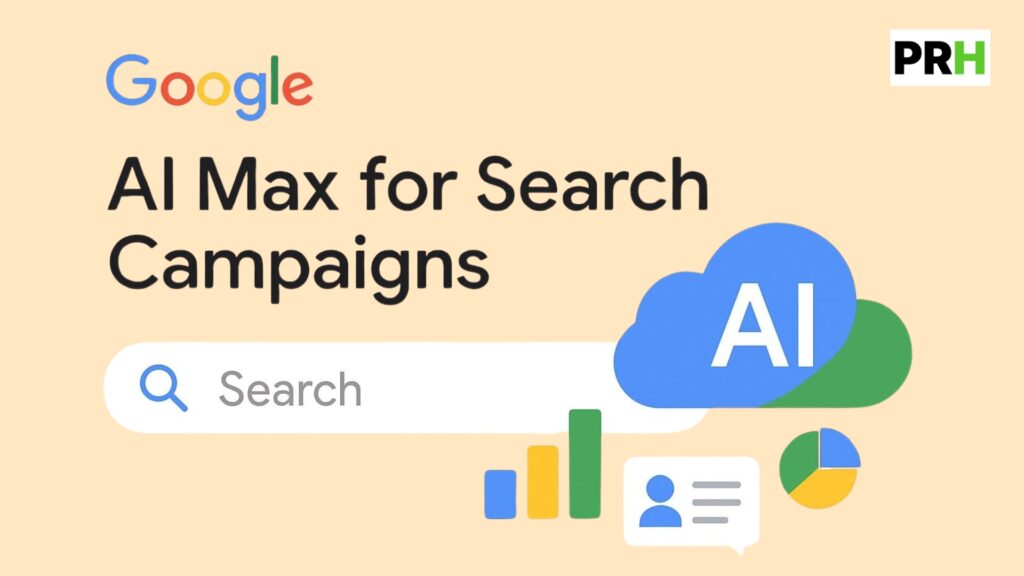

Google’s newest AI-powered advertising feature promises up to 27% more conversions but independent testing reveals significant risks for small local businesses—with only 16% of advertisers reporting good results in industry surveys. For party rental and bounce house companies, AI Max presents a double-edged sword: potential to capture more “bounce house rental near me” searches versus real danger of wasted budget on irrelevant queries and competitors. This comprehensive guide breaks down exactly what AI Max does, what’s working, what’s failing, and whether it makes sense for your rental business.
What AI Max actually does to your Search campaigns
AI Max for Search campaigns, announced on May 6, 2025, is not a new campaign type but rather a feature suite you can toggle on within your existing Google Ads Search campaigns. Think of it as an AI-powered expansion layer that sits on top of your current keyword-based advertising.
When enabled, AI Max adds three major capabilities that fundamentally change how your ads work. First, search term matching uses Google’s AI to show your ads to people searching for related queries you never explicitly targeted—going beyond your chosen keywords to find searchers based on intent. Second, text customization (formerly called “Automatically Created Assets”) generates new headlines and descriptions by reading your website content. Third, final URL expansion can automatically send visitors to different pages on your website that Google’s AI determines are most relevant to their search.
For a bounce house rental company, this means AI Max might show your ads for searches like “kids birthday party entertainment ideas” or “backyard party setup services” even if those exact phrases aren’t in your keyword list. The AI reads your website, learns you offer bounce houses, and tries to match you with searchers who might want your services.
The key difference from standard Search campaigns: In traditional campaigns, you control exactly which keywords trigger your ads and which landing pages visitors see. With AI Max, Google’s AI takes your keywords as “suggestions” and expands aggressively beyond them. Your exact match keywords become starting points rather than boundaries.
Requirements to use AI Max
AI Max requires Smart Bidding strategies focused on conversions—manual CPC bidding won’t work. Your campaign must use Maximize Conversions, Maximize Conversion Value, Target CPA, or Target ROAS. Google recommends a minimum $50/day budget (roughly $1,500/month) and at least 30 conversions in the past 30 days for the AI to learn effectively.
How the AI makes targeting decisions behind the scenes
Understanding AI Max’s decision-making helps explain both its potential and its problems. The system operates through three interconnected mechanisms that work together in the ad auction.
Search term matching combines Google’s broad match technology with “keywordless” targeting similar to Dynamic Search Ads. The AI analyzes your existing keywords, ad copy, and landing pages to understand your business, then shows ads on searches it predicts are relevant—even without any keyword match. If someone searches “inflatable party rentals for kids birthday,” AI Max might determine this matches your bounce house business and serve your ad, regardless of whether “inflatable party rentals” appears in your keyword list.
Text customization uses generative AI to write new headlines and descriptions in real-time. The AI scans your landing pages for marketing messages, unique selling points, and service descriptions, then composes ad copy it believes will resonate with specific searchers. For a party rental business, it might pull “Free Delivery Within 20 Miles” from your website and create a headline around it, or generate descriptions mentioning your specific bounce house models.
Final URL expansion maintains an index of your website pages and selects which page to send visitors to based on their query. A search for “water slide rental” might land on your water slide page even if your ad group’s default URL points to your general bounce house page. The AI predicts which page will convert best.
What control you keep versus lose
This is where AI Max becomes concerning for small businesses. You retain control over turning AI Max on/off, campaign budgets, bidding strategies, negative keywords, brand exclusions, and the ability to remove AI-generated assets after they appear. You lose control over pre-approving AI-generated ad copy before it goes live, ensuring RSA pinning works (it doesn’t when Final URL expansion is enabled), selecting exactly which landing page visitors see, and preventing the AI from expanding beyond your keywords.
The practical impact: your carefully crafted “Book Your Bounce House Today” headline might be replaced with AI-generated text, and searchers might land on your about page instead of your booking form.
Recent updates changed how AI Max operates
AI Max evolved rapidly through 2025 after its May announcement. The open beta launched May 27, 2025, making it available to all advertisers globally. Google introduced several refinements in response to advertiser feedback.
In July 2025, a new “AI Max” match type appeared in search term reports, allowing advertisers to see which queries came from AI expansion versus their actual keywords. A “source column” now indicates whether matches came from broad match expansion or keywordless matching—critical for understanding what’s driving performance.
August 2025 brought AI Max experiments, enabling 50/50 split testing within a single campaign. This eliminated the need for duplicate campaigns to test the feature, though results auto-apply by default (which you should turn off).
The most significant update came in September 2025 with text guidelines—a feature allowing advertisers to provide natural language instructions limiting AI-generated content. You can now block up to 25 specific words or phrases and add up to 40 messaging restrictions like “never mention competitor names” or “always emphasize local service.” This addresses a major control gap but remains in limited rollout.
By December 2025, Google announced AI Max as “the fastest-growing AI-powered Search ads product” and confirmed text guidelines will expand to all advertisers in Q1 2026. Text customization is now available in all languages and verticals.
Performance data paints a mixed picture for local services
Google’s official numbers sound impressive: 14% more conversions at similar cost for average advertisers, and 27% improvement for campaigns previously relying on exact and phrase match keywords. Case studies from L’Oréal (2X higher conversion rate), ClickUp (22% lower CPA), and MyConnect (16% more leads) reinforce the success narrative.
However, independent testing tells a different story for smaller advertisers. A LinkedIn poll by PPC consultant Adriaan Dekker found only 16% of respondents reported “good performance” from AI Max. Testing by Smarter Ecommerce across 250+ campaigns showed AI Max delivered 35% lower ROAS compared to traditional match types.
The most concerning finding for local businesses comes from Xavier Mantica’s four-month test, which showed AI Max cost $100.37 per conversion versus $43.97 for phrase match—more than double the cost. Another analysis found 99% of impressions generated zero conversions across approximately 30,000 search terms matched through AI Max features.
Local service business testing results
Testing on an audio/video system installer (a comparable home services business) over 30 days revealed AI Max generated 8 of 34 total leads at a $122 CPA versus $112 for non-AI Max traffic—9% higher cost per lead. More problematic were the irrelevant matches: the AI targeted competitor brand terms, stretched “TV installer” to match “TV repair” searches, and served ads for unadvertised services it found on the website.
For service-area businesses, AI Max introduces “Locations of Interest” targeting that can capture searchers showing geographic intent even when physically elsewhere. Someone in Chicago searching “Phoenix bounce house rental” could see your Phoenix-area ad. This benefits party rental companies serving tourists or event planners booking remotely, but requires careful configuration to avoid geographic waste.
Budget realities for small businesses are stark. Google’s recommended $50/day minimum means $1,500/month at least, with optimal performance requiring higher spend. The 1-2 week learning period consumes budget while the AI experiments, and campaigns already limited by budget often see performance degrade rather than improve with AI Max.
Real problems advertisers are reporting
The most frequent complaint involves irrelevant search term matching. Independent testing documented AI Max triggering ads for single-word queries like “home” with no context, and matching “buy England furniture online” to an American company with a “Made in USA” headline. Users report 15-20% budget waste on off-topic queries since the May 2025 launch.
Competitor brand targeting emerged as a major issue. Mike Ryan of Smarter Ecommerce found that competitor brand terms accounted for 69% of total impressions in one AI Max campaign. For a party rental business, this means your budget could flow toward people searching for “Joe’s Bounce Houses” (your competitor) rather than generic service queries—leading to clicks from people specifically looking for someone else.
Geographic targeting creates confusion for local businesses. AI Max’s “Locations of Interest” feature operates separately from campaign-level location targeting, and the interaction between them isn’t intuitive. Advertisers report ads appearing outside their service areas when searchers include location words that differ from the advertiser’s target area.
Loss of creative control frustrates brand-conscious advertisers. AI-generated headlines and descriptions go live automatically—you can only remove them after they’ve already run. Brad Geddes of Adalysis found that when Final URL expansion is enabled, RSA pinning is completely ignored, meaning your carefully structured ad rotations get overridden. One tester saw AI Max serve a “Made in USA” headline to someone explicitly searching for England-based products—the opposite of user intent.
Match type confusion compounds attribution problems. Geddes documented how “AI Max treats all keywords as broad match regardless of their specified match type.” Your exact match keywords may show performance that actually combines exact match, phrase variants, AND AI Max expansion, making it impossible to know what’s really working.
Weighing benefits against risks for party rental companies
Potential benefits worth considering
Expanded reach for long-tail queries represents AI Max’s strongest appeal. Party rental businesses might capture conversational searches like “what do I need for a backyard birthday party” or “fun activities for kids outdoor party” that traditional keyword targeting misses. These discovery queries can bring customers earlier in their planning process.
Time savings on campaign management matters for small business owners juggling multiple responsibilities. AI Max handles keyword expansion, ad copy generation, and landing page selection automatically, potentially reducing hours spent on manual optimization.
Seasonal adaptation could benefit event-focused businesses. The AI continuously learns from current search patterns, potentially capturing emerging trends (like a viral party theme) faster than manual keyword research allows.
Location intent capture helps when event planners search remotely. Someone planning a wedding in your city while physically elsewhere could find you through AI Max’s geographic intent matching.
Significant risks requiring consideration
Budget waste on irrelevant traffic is well-documented and particularly painful for small businesses with limited marketing dollars. The $50/day minimum means you’re committing at least $1,500/month to test a feature that may consume 15-20% on off-topic queries.
Competitor targeting eats your budget when AI Max shows your ads to people searching for competitors by name. Unlike branded keyword strategies you control, this happens automatically and may result in expensive clicks from people who wanted someone else.
Geographic sprawl could mean paying for clicks from areas you can’t serve. A bounce house company serving a 25-mile radius might find AI Max showing ads to searchers 50 miles away who mentioned a city name in their query.
Brand messaging inconsistency occurs when AI-generated headlines don’t match your voice. The AI might emphasize features you don’t want highlighted or miss your key differentiators entirely.
Small budget disadvantage is structural. With fewer than 30 monthly conversions, the AI lacks data to learn effectively. Your limited budget funds Google’s experimentation rather than proven strategies.
Expert perspectives span supportive to deeply skeptical
Critical voices dominate independent testing circles. Brad Geddes (Adalysis) argues AI Max “creates fundamental attribution problems” and “claims credit for conversions that would have occurred through existing exact and phrase match keywords.” Anthony Higman dismissed it as “Just Broad Match Keywords + DSA in a shiny new AI wrapper,” calling it “a non-precision tool” and “either a YOLO move or a Hail Mary pass.”
Mike Ryan of Smarter Ecommerce called the Search Partner Network expansion behavior “deeply disturbing” and found AI Max consistently delivered lower ROAS than traditional targeting. One agency bluntly predicted: “This, like so many automations before it, is going to eat budgets. Thus, in a couple of months we’ll hear many horror stories about AI Max.”
Grow My Ads titled their analysis “Why 99% of Businesses Will Lose Money” on AI Max, specifically warning that smaller accounts not already succeeding with broad match should avoid it entirely.
Supportive perspectives come primarily from Google and agencies with early access to refined implementations. Jyll Saskin Gales, former Googler and PPC consultant, advocates patience: “AI Max reflects Google’s shift to a search experience centered around intent prediction rather than strict keyword matching.” She compares broad match learning to teaching a toddler—it requires correction but improves over time.
Google’s Ads Product Liaison Ginny Marvin emphasizes that AI Max is opt-in with granular controls: “Google is bringing advertisers more control and transparency—not less.” The text guidelines feature arriving in 2026 represents Google’s response to control complaints.
The balanced view from experienced practitioners: AI Max may work well for large accounts with substantial budgets and robust conversion data but remains risky for small businesses without those foundations. PPC Strategist summarized: “I’m on the fence—with about 70% of me hovering over the skeptical side.”
Practical recommendations for party rental businesses
Decision framework: Enable AI Max only if you meet these criteria
Your campaign should already be successfully using broad match keywords with acceptable cost per lead. You need at least $50/day budget that isn’t currently limited by budget constraints. Your account should show 30+ conversions monthly for the AI to learn from. Smart Bidding must be enabled, and your website should have clear, accurate service pages the AI can read.
For most party rental companies, the answer is probably “not yet.” If you’re spending under $1,500/month, have fewer than 30 monthly conversions, haven’t successfully used broad match, or need tight control over your service area targeting, AI Max introduces more risk than reward at its current maturity level.
If you decide to test, follow this configuration
Start by running a 50/50 experiment rather than enabling AI Max across your full campaign. This limits exposure while providing comparative data.
Disable Final URL expansion initially. This feature causes the most control problems, sending visitors to unintended pages and overriding your ad structure. Keep visitors on your conversion-optimized landing pages.
Configure brand exclusions immediately. Add competitor names to prevent AI Max from spending your budget on their branded searches. Update this list as you discover new competitors in your search terms report.
Set up URL exclusions to block non-converting pages like your blog, FAQ, about, contact, and privacy policy pages. Only allow landing pages designed to generate leads.
Enable Locations of Interest at the ad group level matching your service area. If you serve “Houston area,” add Houston as a location of interest so keywordless targeting respects your geographic focus.
Monitoring protocol during testing
Daily search term review is mandatory for the first two weeks. Filter for “Search terms and landing pages from AI Max” to see exactly what queries triggered your ads and where visitors landed. Add negative keywords immediately for irrelevant matches.
Track CPA by match type to compare AI Max performance against your traditional keywords. If AI Max CPA exceeds your target by more than 50% after three weeks with no improvement trend, disable the feature.
Review AI-generated assets weekly. Check the asset report for any headlines or descriptions that don’t fit your brand voice, make inaccurate claims, or emphasize the wrong services. Remove problematic assets.
Monitor geographic distribution in your location reports. Watch for clicks from areas outside your service radius that shouldn’t be triggering your ads.
Warning signs to disable AI Max
Shut it off if search terms include generic single words with no buying intent. Disable if competitor brand queries appear frequently despite exclusions. Turn off if CPA remains 50%+ above target after 3-4 weeks. Remove if AI Max consumes disproportionate budget (say 60%) while delivering minimal conversions (under 30%).
Conclusion
AI Max represents Google’s vision of intent-based advertising where keywords become suggestions rather than boundaries. For large advertisers with substantial budgets and conversion volume, it can unlock incremental reach and reduce manual optimization work. For small local businesses like party rental companies, the current reality is less promising: only 16% of advertisers report good results, independent testing shows significantly higher costs than traditional targeting, and the minimum budget requirements exclude many small businesses from effective use.
The wisest approach for most party rental companies is waiting 6-12 months for Google to refine the product and for text guidelines to become widely available. If you do test, use the experiment framework, disable Final URL expansion, configure exclusions aggressively, and monitor daily. The $50/day minimum means this isn’t a casual experiment—it’s a commitment of at least $1,500 over a month of testing.
For now, well-structured Search campaigns with carefully chosen keywords, strong negative keyword lists, and manual landing page selection likely deliver better results per dollar for local service businesses. AI Max may eventually mature into a valuable tool, but it’s not there yet for the party rental industry.