
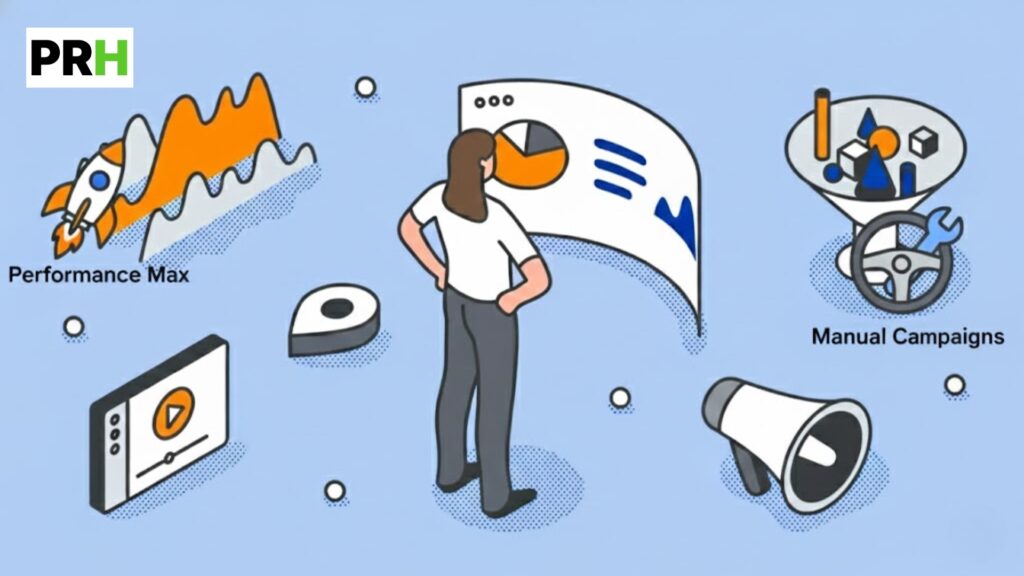

The bottom line for party rental operators: Start with Search campaigns if your budget is under $1,500/month, then add Performance Max once you’re generating at least 30 conversions monthly. This hybrid approach gives you the control needed for local service businesses while eventually unlocking Google’s AI-powered reach across YouTube, Maps, Display, and Gmail. Party rental companies face unique challenges—seasonal demand, weekend-heavy bookings, parent decision-makers researching safety, and tight geographic service areas—that make the choice between these campaign types more nuanced than Google’s marketing suggests.
This decision directly impacts whether your ad dollars reach parents actively searching “bounce house rental near me” or get spread across Display Network sites where clicks are cheap but bookings are rare. The good news: recent 2024-2025 updates have dramatically improved Performance Max transparency, making hybrid strategies more viable than ever for local businesses.
How Performance Max actually works under the hood
Performance Max represents Google’s most ambitious automation bet—a single campaign type that runs ads across all Google properties simultaneously. Unlike traditional campaigns where you build separate Search, Display, and YouTube campaigns, PMax uses machine learning to decide where your ads appear, what creative combinations to show, and how much to bid at each auction.
Google’s AI controls five critical elements: real-time bidding for each auction, dynamic budget distribution across channels, automatic creative assembly from your uploaded assets, audience expansion beyond your initial signals, and placement selection across Search, Display, YouTube, Gmail, Maps, and Discover. The system creates thousands of ad variations by mixing your headlines, descriptions, and images, then tests which combinations drive conversions.
The learning period requires patience most small business owners underestimate. Google officially recommends six weeks for meaningful performance comparison, with the first two to four weeks dedicated to testing bids, audiences, and creative combinations. PMax works best with at least 30 conversions per month (ideally 60+), which creates an immediate problem for smaller party rental operators who might generate 10-15 bookings monthly.
Asset requirements are substantial: you’ll need 3-15 headlines (30 characters each), 1-5 long headlines (90 characters), 2-5 descriptions, landscape images (1200×628), square images (1200×1200), and ideally custom videos. If you skip video uploads, Google auto-generates videos from your images—often resulting in low-quality, off-brand creative that can hurt your business perception.
The transparency limitations have been Performance Max’s biggest criticism. Historically called a “black box,” PMax now offers campaign-level negative keywords (up to 10,000 per campaign), brand exclusions, and channel-level performance reporting launching in 2025. You can finally see whether your budget went to Search versus YouTube versus Display, though you still cannot opt out of specific channels or control budget allocation between them.
Manual campaigns offer control at the cost of complexity
Search campaigns remain the gold standard for capturing high-intent customers. When a parent searches “tent rental for graduation party near me,” a well-optimized Search campaign puts your ad directly in front of someone ready to book. The average Search CTR runs around 3.17% compared to PMax’s 1.19%, because Search targets people actively looking rather than passively browsing.
Keyword match types give you surgical precision: Exact match ([bounce house rental]) triggers only for searches with identical meaning, delivering the highest ROAS (415% according to Optmyzr’s 2024 analysis) but narrowest reach. Phrase match (“party tent rental”) captures searches containing your phrase. Broad match triggers for related searches but requires careful negative keyword management to avoid irrelevant clicks. For party rentals, start with exact and phrase match on high-intent terms, then cautiously expand to broad match with Smart Bidding once you have conversion data.
Quality Score directly impacts what you pay. Google rates keywords 1-10 based on expected click-through rate (39% weight), landing page experience (39%), and ad relevance (22%). A score above 7 means lower costs and better positions; below 5 signals problems requiring immediate attention. For local businesses, this means your landing page must closely match ad messaging—don’t send “bounce house rental” clicks to your general homepage.
Display campaigns work differently and often poorly for direct response. While they reach users across millions of websites, they’re better suited for remarketing (showing ads to people who already visited your site) than cold prospecting. Remarketing requires minimum 100 users for Display and 1,000 for Search audiences. For most party rental businesses, Display without remarketing burns budget on low-quality placements.
Local Service Ads deserve special mention: they appear above regular Google Ads, use pay-per-lead pricing (not pay-per-click), and display a Google Guarantee badge after verification. However, they’re only available in specific service categories and may not include party rentals in all markets. The badge builds trust with parents but requires background checks and insurance verification.

Budget realities small rental operators must face
The uncomfortable truth: Performance Max needs $1,500-3,000/month minimum to function properly. Expert consensus puts the daily budget floor at $50-100 for adequate learning data, with best practice at 3x your target cost-per-acquisition. If your CPA goal is $50, you need $150/day minimum—roughly $4,500/month.
Search campaigns work with far smaller budgets. Party rental businesses can start at $300-500/month with focused campaigns targeting high-intent keywords. The industry benefits from relatively low CPCs compared to competitive sectors like legal or insurance—optimized campaigns can achieve clicks under $1, though $1-3 is more typical for “near me” searches.
For budgets under $1,000/month, avoid Performance Max entirely. The algorithm needs substantial conversion data to learn effectively, and limited budgets extend the learning phase indefinitely while spreading spend too thin across channels. Search campaigns let you control exactly where every dollar goes, ensuring it targets people actively looking to book party equipment rather than casually browsing YouTube.
The cost-per-lead varies significantly by approach. E-commerce-style PMax campaigns average around $51 CPA with 5.9% conversion rates. B2B and professional services using Search campaigns average $58 CPA with 5.2% conversion rates. Party rentals typically fall between these benchmarks, though seasonal peaks can dramatically improve economics during graduation and wedding seasons.
Seasonal and geographic strategies for party rentals
Party rental businesses face pronounced seasonality that affects campaign strategy. Peak periods—spring through summer, graduation season in May, July 4th, fall festivals, and wedding season—can generate 60-70% of annual revenue. Google’s Seasonality Adjustments feature lets you inform Smart Bidding about expected conversion rate changes during these peaks, improving performance without manual bid management.
The critical mistake is pausing campaigns during slow periods. Pausing disrupts the learning phase and prolongs recovery when you restart. Instead, reduce budgets during off-seasons while maintaining campaign continuity. Create separate seasonal campaigns with specific messaging—”Graduation Party Tents Available” or “Summer Bounce House Specials”—that you can scale up or down as demand shifts.
Plan PMax launches 4-6 weeks before peak seasons to give the algorithm time to learn before your highest-demand period. Launching PMax in the middle of graduation season means burning budget during the learning phase when conversions matter most.
Dayparting matters for party rentals given the weekend-heavy booking pattern. Most event planning happens during evenings and weekends when parents have time to research. Analyze your Day and Hour performance reports in Google Ads, then increase bids during high-converting times. If Saturday evenings convert at twice the rate of Tuesday afternoons, adjust bids accordingly.
Geographic targeting requires precision. Use radius targeting of 25-50 miles depending on your actual delivery range, and critically, select “Presence: People in or regularly in your targeted locations” rather than “People interested in your targeted locations.” The latter wastes budget on people researching party rentals in your city from across the country. Add negative location targeting for areas outside your service range.
Google Business Profile integration drives local visibility
For local service businesses, Google Business Profile integration can unlock visibility in Google Maps, local pack results, and “near me” searches. Link your GBP during PMax campaign setup—connecting after setup often doesn’t work properly. The connection enables Maps ads, local action tracking (direction clicks, call clicks), and store visit conversions if you have sufficient foot traffic.
Performance Max for Store Goals specifically targets businesses with physical locations, promoting across Maps, Waze (US only), Search local pack, YouTube, Gmail, and Display. When local assets are connected, PMax serves ads showing your business location as promoted pins in Maps navigation, maps autocomplete suggestions, and local search results.
Requirements for location assets include a verified Google Business Profile linked to your Google Ads account, accurate hours and contact information, and high-quality photos. Google recommends 5-10 business locations minimum for campaigns optimizing for store visits, which may disqualify single-location party rental operations from some local features.
Reviews directly impact ad performance. Seller ratings (showing stars in search ads) require 100+ reviews from approved review partners in the past 12 months. For Local Service Ads, review quantity and quality factor into ranking alongside proximity and responsiveness. Prioritize review collection as part of your advertising strategy—150 reviews at 4.8 stars typically outperforms 30 reviews at 5.0.
Brand search protection prevents budget waste
Performance Max has a well-documented tendency to claim credit for branded searches—people searching your company name who would have found you anyway. Without restrictions, PMax can spend 50%+ of budget on brand traffic, inflating its performance metrics while providing zero incremental value. Studies show 10-42% of PMax conversions typically come from brand searches.
The solution is brand exclusions, now available to all advertisers. Navigate to PMax campaign settings, find Brand exclusions, and add your brand name plus variations and common misspellings. This works like negative broad match, automatically blocking variations. Note that exclusions only affect Search and Shopping placements, not Video or Display.
The recommended structure for established businesses: exclude your brand from Performance Max, then create a separate Branded Search campaign using exact and phrase match keywords for your company name. This dedicated campaign captures brand traffic cheaply (since you’re the only relevant advertiser) while PMax focuses on acquiring genuinely new customers.
Case studies show excluding brand from PMax reduced customer acquisition costs by 19-60% while providing more accurate performance measurement. The exception: very small budgets under $20,000/month annual spend may not justify the added complexity of managing separate brand and non-brand campaigns.
Building trust with parent decision-makers
Party rental purchases involve significant trust considerations—parents are renting equipment their children will use. Effective ads and landing pages must address these concerns directly. Insurance and safety messaging belongs in ad copy: “Fully Insured & Licensed,” “Commercial-Grade Equipment,” “Sanitized After Every Event.” Most venues require liability insurance proof (typically $1-2 million coverage), and mentioning this builds credibility with experienced event planners.
Review integration provides powerful social proof. If you qualify for seller ratings (100+ reviews), they display automatically in search ads. For Local Service Ads, the Google Guarantee badge appears after background checks and insurance verification—particularly valuable for businesses where trust determines bookings.
Ad copy that converts for party rentals combines urgency (“Limited Weekend Slots,” “Same-Day Availability”), trust (“Rated #1 in Local Reviews,” “Over 500 Successful Events”), and clarity (“Free Delivery Within 10 Miles,” “Packages Starting at $99”). Test different angles—some markets respond better to pricing hooks while others prioritize safety messaging.
Landing pages must reinforce ad promises immediately. If your ad promotes bounce houses, visitors should see bounce house photos prominently, not a generic homepage. Include customer testimonials with names and event photos, display safety certifications, explain your cleaning and inspection protocols, and make quote requests or booking obvious. Many party rental sites bury contact information—this directly reduces conversions.
Conversion tracking setup most businesses skip
Without proper conversion tracking, neither Search campaigns nor Performance Max can optimize effectively. Google’s AI needs conversion signals to learn which clicks turn into bookings. Track three primary conversions: phone calls (set 60-second minimum duration to filter tire-kickers), form submissions (quote requests and contact forms), and online booking completions.
Google’s free call tracking replaces your phone number with a trackable forwarding number, capturing call time, duration, and caller area code. However, it doesn’t record calls or provide insight into lead quality. Third-party platforms like CallRail or Nimbata offer recordings, transcripts, lead scoring, and GCLID capture for importing offline conversions—worth the investment for businesses where phone calls drive significant bookings.
Form tracking requires either thank-you page tracking (redirecting to a confirmation page after submission) or Google Tag Manager event tracking. For embedded booking systems like Acuity or Cliniko, the iframe often breaks tracking—consider linking to a hosted booking portal that preserves attribution data.
Assign conversion values to train Google’s AI effectively. If 1 in 4 phone calls becomes a $200 booking, each call is worth $50. Form submissions might be worth less if they convert at lower rates. Online bookings should capture actual transaction values. Value-based bidding strategies (Maximize Conversion Value, Target ROAS) use these signals to prioritize high-value conversions over raw volume.
Common mistakes that waste party rental ad budgets
Performance Max mistakes cluster around insufficient setup and unrealistic expectations. Poor creative assets—using only 3 headlines instead of 15, or relying on auto-generated videos—limit placement eligibility and performance. Insufficient budget (under $50/day) prevents the learning phase from completing. Expecting results in the first week leads to premature changes that reset learning. Not providing audience signals (uploading customer lists, defining target demographics) forces the algorithm to start from scratch.
The single biggest PMax mistake for local businesses: dumping everything into one asset group. Create separate asset groups by service category—inflatables, tents, tables and chairs, photo booths—so the algorithm can optimize each product line independently. One asset group for everything limits optimization and makes reporting meaningless.
Search campaign mistakes often involve keyword management. Using broad match without sufficient negative keywords bleeds budget on irrelevant searches. Failing to add negative keywords for “jobs,” “free,” “used,” and “DIY” wastes clicks on non-customers. Creating one ad per ad group prevents testing. Sending all traffic to the homepage instead of service-specific landing pages tanks conversion rates.
Local business-specific mistakes: targeting entire states instead of delivery radius, ignoring Google Business Profile connection, not using location extensions, inconsistent NAP (name, address, phone) across web properties, and not tracking phone calls when calls drive most bookings.
The right approach depends on your situation
For new party rental businesses or budgets under $1,000/month: Start with Search campaigns exclusively. Target high-intent keywords like “[City] bounce house rental” and “party tent rental near me” using exact and phrase match. Build your Google Business Profile, collect reviews, and establish conversion tracking. This foundation is necessary before PMax can work.
For established businesses with $1,500-3,000+/month budgets and 30+ monthly conversions: Run a hybrid strategy. Keep Search campaigns for high-intent keywords and brand terms. Add Performance Max with brand exclusions enabled to expand reach across YouTube, Display, Maps, and Gmail. Let Search capture known demand while PMax discovers new audiences.
The power pair structure: Search campaign handles brand terms plus high-converting exact match keywords. Performance Max handles prospecting with brand exclusions, providing multi-channel reach without cannibalizing your branded traffic. Monitor the Search Terms Insights in PMax to ensure overlap stays minimal.
For highly seasonal businesses: Build campaigns 4-6 weeks before peak seasons. Use Seasonality Adjustments rather than pausing campaigns during slow periods. Create seasonal ad copy highlighting graduation parties, summer events, or wedding themes as relevant. Reduce budgets during off-seasons rather than pausing entirely.
Key 2024-2025 updates that change the calculus
Several recent Google Ads changes make Performance Max more viable for local businesses than it was even a year ago. Campaign-level negative keywords (up to 10,000 per campaign) let you exclude irrelevant searches without contacting Google support. Brand exclusions are now self-service, making hybrid strategies practical. Channel-level performance reporting launching in 2025 finally reveals how budget distributes across Search, YouTube, Display, and other placements.
Enhanced CPC bidding was deprecated as of March 2025, pushing more advertisers toward fully automated Smart Bidding strategies. Performance Max and Standard Shopping campaigns now compete based on Ad Rank rather than automatic PMax priority, improving Shopping campaign viability alongside PMax.
For Search campaigns, misspelling improvements mean negative keywords now automatically block misspelled variations. The “AI Max for Search” product offers a middle ground between full manual control and Performance Max automation—worth testing for advertisers uncomfortable with PMax’s full automation.
Conclusion
The Performance Max versus manual campaigns decision ultimately depends on your budget, conversion volume, and need for control. Party rental businesses with limited budgets should start with Search campaigns targeting high-intent local keywords, building the conversion data and review foundation that makes Performance Max effective later.
Once you’re generating 30+ monthly conversions with $1,500+ monthly budget, adding Performance Max with proper brand exclusions expands your reach without sacrificing the control Search provides. The hybrid approach—Search for known demand, PMax for discovery—works particularly well for seasonal businesses that can scale both campaign types during peak periods.
The most important takeaway: conversion tracking must be in place before any campaign type can succeed. Track calls, forms, and bookings with assigned values. Without this data, Google’s algorithms are flying blind, and your ad spend becomes an expensive experiment rather than a measurable investment in business growth.