
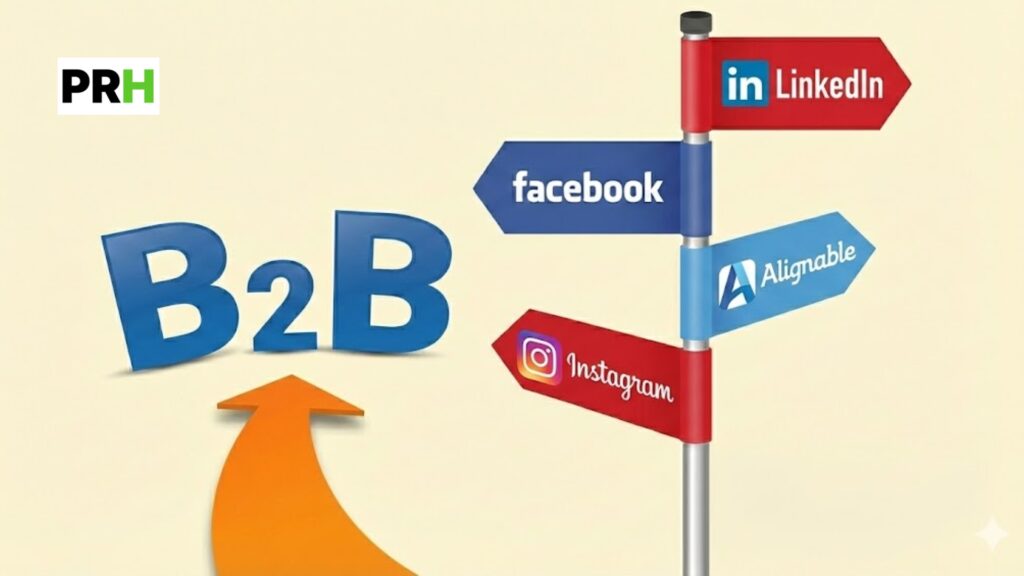

The party rental industry is experiencing 10-15% annual growth through 2030, and social media has become the primary channel for customer acquisition—with 58% of consumers now discovering local businesses through social platforms. For party rental companies seeking to reach both family customers (B2C) and corporate/institutional clients (B2B), a platform-specific strategy dramatically outperforms generic social media approaches.
The most effective approach combines Instagram’s visual power for wedding and event discovery (nearly 90% of brides use it to find vendors) with LinkedIn’s B2B dominance (80% of B2B leads come from LinkedIn) and Facebook Groups for industry networking. Meanwhile, Alignable—a platform often overlooked by party rental businesses—offers the strongest opportunity for building local referral partnerships with complementary vendors like caterers, photographers, and venues.
LinkedIn unlocks corporate accounts and institutional buyers
LinkedIn represents an underutilized goldmine for party rental businesses targeting corporate event planners, HR departments, school administrators, and wedding professionals. While it won’t replace Instagram for consumer bookings, LinkedIn generates 3x higher conversion rates than other social platforms for B2B leads and reaches 80% of members who influence business decisions in their organizations.
For party rental businesses, the key decision-makers to target include corporate event planners (search “Event Manager” or “Corporate Events”), HR managers who organize company picnics and team-building events, executive assistants coordinating functions, school administrators planning graduations and carnivals, and church ministry directors. LinkedIn’s advanced search filters allow targeting by job title, company size, industry, and geographic location within your service area.
Content strategy on LinkedIn should follow the 3-2-1 model: three pieces of industry-related content weekly (like event planning tips), two pieces of “proud” content (successful corporate event setups, employee spotlights), and one promotional piece. Carousel posts generate 11.2x more impressions than text-only posts, making them ideal for showcasing before/after corporate event transformations. Joining groups like Meeting Professionals International (397,000+ members) and Event Manager Blog Community (333,000+ members) provides direct access to event professionals actively seeking vendors.
Company page optimization requires completing all profile sections—pages with complete profiles receive 30% more weekly views. The About section should include service-area keywords (“Dallas party rentals,” “corporate event equipment Houston”), service keywords (“tent rentals,” “table and chair rental”), and B2B-specific terms (“corporate event solutions”). Posting weekly maintains algorithmic visibility, and personalized connection requests should reference the prospect’s company or role rather than leading with sales pitches.
Alignable provides local B2B referral partnerships most businesses miss
Alignable is North America’s largest small business networking platform, with over 9 million members across 35,000+ local communities—yet most party rental businesses have never heard of it. Unlike LinkedIn’s global professional focus, Alignable specifically connects local small business owners for referrals and partnerships, making it ideally suited for building relationships with caterers, photographers, venues, DJs, florists, and other event vendors.
The platform operates on a “give first” philosophy where members exchange genuine recommendations and referrals. Party rental businesses can define their “Ideal Partners” (event planners, caterers, photographers) and “Ideal Customers” (corporate HR, churches, schools) directly in their profiles, and Alignable’s AI suggests relevant local connections. The recommendation system awards “Highly Recommended” badges that boost credibility, following a best practice of writing five recommendations for every one requested.
Free accounts limit connections to just 5 per month within a 6-mile radius. The Growth plan ($29/month) expands to 15 connections with basic analytics, while the Pro plan ($49/month) offers 25 connections and advanced features. For party rental businesses, the ROI calculation is straightforward: one client referral from a vendor partnership typically covers 6-12 months of membership fees.
Success on Alignable requires consistent engagement—participating in Q&A forums, attending Smart Connect virtual networking events (speed-dating style introductions), and scheduling virtual coffee chats with new connections. Users who became active and consistent report results like “after Google, it is our next best online referral tool” and “Alignable has given me more work than all the other platforms combined.” The key is treating it as relationship-building rather than lead generation; aggressive sales pitches violate community norms and damage reputation.
Instagram and Facebook Groups drive both B2B and B2C results
Instagram functions as the visual workhorse for party rental marketing, serving both family customers seeking birthday party inspiration and event professionals scouting vendors. With 3 billion monthly active users and Reels accounting for 50% of time spent on the app, short-form video content has become essential. Time-lapse videos of bounce house setups, before/after event transformations, and “set up with us” series consistently outperform static posts.
For B2B specifically, Instagram excels at reaching wedding planners and corporate event coordinators through strategic collaboration. Tagging photographers, florists, and venues in event photos creates cross-promotional reach, while participating in styled shoots generates portfolio content that attracts professional clients. The hashtag strategy should combine general event industry tags (#eventplanner, #weddingvendor), rental-specific tags (#partyrentals, #tentrentals), and location-based tags (#DallasWeddingVendor, #HoustonEvents). Placing 10-15 relevant hashtags in the main caption—rather than comments—carries more algorithmic weight.
Facebook Groups offer superior B2B networking compared to Facebook Pages, which have seen declining organic reach. Wedding planner communities, corporate event planning groups, and local business networking groups provide free access to qualified leads when approached correctly. The key is providing value first: answering questions, sharing helpful tips, and avoiding promotional content until relationships are established. Industry-specific groups where party rental professionals share efficiency tricks and cross-refer clients represent particularly valuable resources.
Nextdoor offers hyperlocal visibility unmatched by other platforms, with 79% of neighbors influenced by recommendations to visit businesses. While primarily B2C-focused (reaching local parents planning parties), Nextdoor also connects businesses with HOAs, community groups, property managers, and local organizations seeking event services. Claiming and optimizing a free Business Page, encouraging customer recommendations, and engaging in community conversations (not just promotional posts) builds neighborhood credibility.
Content strategy and seasonal planning determine booking volume
Visual quality separates successful party rental social media from ineffective efforts. 66% of social media users consider short-form video the most engaging content type, while high-quality event photography builds the credibility that leads corporate and institutional clients to book. Before/after transformation content, setup time-lapses, kids enjoying bounce houses (with permission), and inventory showcases styled for different events consistently drive engagement.
The content mix should follow the 80/20 rule: 80% valuable content (educational tips, event inspiration, behind-the-scenes) and 20% promotional (offers, availability announcements). Customer testimonials with photos create powerful social proof—84% of people trust online reviews as much as personal recommendations. Video testimonials captured at events represent the most persuasive format, while branded graphics featuring review quotes work well for regular posting.
Seasonal content planning aligns with demand cycles:
- Spring/Summer peak: Feature water slides and wet inflatables, graduation party packages (May-June), outdoor tent setups, and Fourth of July themes while posting availability updates as weekends fill
- Fall: Halloween-themed bounce houses, fall festival content, back-to-school event packages for schools and PTAs
- Winter: Holiday party rental packages, corporate holiday event showcases, indoor event solutions
- Off-season: Early-bird booking promotions, new inventory reveals, equipment maintenance behind-the-scenes, relationship-building content
For B2B credibility specifically, showcasing insurance certifications, safety training, and equipment inspection processes addresses the due diligence requirements of corporate and institutional buyers. Case studies of successful large-scale events—with specific metrics like guest counts and venue challenges overcome—demonstrate capability for complex logistics that organizations require.

Platform priorities and time investment should match business goals
Google Business Profile is non-negotiable for any party rental business—88% of local searchers visit or call a business within 24 hours. Complete optimization includes accurate NAP (Name, Address, Phone), high-quality photos of setups and inventory, regular posting of updates and promotions, and responding to every review within 24 hours. This foundation supports all other social media efforts through local SEO integration.
For businesses with limited time (under 5 hours weekly), the minimum viable strategy includes Google Business Profile optimization, Instagram posting 3-5 times weekly with vendor tagging, and active participation in one Facebook industry group. This combination covers local search visibility, visual portfolio building, and B2B networking basics.
For aggressive B2B growth, LinkedIn becomes essential for corporate account development, requiring 3-5 hours weekly for profile optimization, consistent posting, group participation, and personalized outreach to target decision-makers. Alignable adds structured local networking with complementary vendors, requiring 3-5 hours weekly for relationship-building. The Knot and WeddingWire provide wedding-specific visibility but require paid listings ($125-$1,000+/month depending on market competitiveness) and work best as supplements to organic strategy rather than primary lead sources.
TikTok offers viral potential particularly suited to bounce house and inflatable businesses—one Arizona bounce house company reached 1 million views with a 30-second time-lapse setup video, and TikTok became their primary marketing channel. The platform’s 2.8% average engagement rate (highest of all platforms) and 88% of small businesses reporting sales increases make it worth considering for businesses willing to invest in consistent short-form video creation.
Pinterest functions as a long-term traffic driver, particularly for wedding-focused rentals. Unlike other platforms, Pinterest content continues driving website traffic months after posting, and the platform serves as both social network and search engine—with pins appearing in Google results. Creating themed boards (“Rustic Wedding Rentals,” “Corporate Event Setups,” “Backyard Party Ideas”) with website links on every pin generates sustained discovery.
The data strongly favors video-first, platform-specialized approaches
Current statistics reveal several strategic imperatives for party rental businesses. Short-form video delivers the highest ROI of any content format, with 78% of consumers preferring it for product discovery and viewers retaining 95% of a message watched on video versus 10% read in text. Instagram Reels average 16,152 views per video while TikTok averages 18,173 views—both dramatically outperforming static content.
The party rental industry’s growth trajectory ($16.22 billion globally in 2024, projected to reach $32-37.5 billion by 2030) indicates expanding competition for social media visibility. Digital marketing now accounts for 65% of advertising budgets for wedding businesses, and 68% of mid-to-large events in North America use rental services. Businesses investing in social media now build brand recognition that compounds as the market expands.
For B2B specifically, 75% of B2B buyers and 84% of C-level executives use social media for vendor research before purchasing. LinkedIn’s 6.50% engagement rate in 2025—highest of all platforms—combined with its B2B lead dominance makes it essential for corporate account development. The wedding market alone represents a $300+ billion global opportunity with 90% of couples using social media to find ideas and vendors.
AI adoption is accelerating across social media marketing, with 73% of businesses now using AI for content creation and 60% of marketers using AI tools daily. Party rental businesses can leverage AI for caption writing, content scheduling optimization, and response drafting—reducing the time investment required for consistent social media presence while maintaining authentic engagement.
Conclusion
Party rental businesses face a dual-audience challenge that requires platform specialization rather than identical content everywhere. Instagram serves as the visual portfolio and wedding industry discovery engine; LinkedIn provides access to corporate decision-makers and institutional buyers; Facebook Groups enable vendor networking and referral partnerships; Alignable offers structured local B2B relationship-building; and Google Business Profile anchors local search visibility.
The most successful approach starts with Google Business Profile optimization and Instagram consistency, then expands to LinkedIn for B2B account development and Alignable for vendor partnership building. TikTok and Pinterest offer growth acceleration for businesses ready to invest in specialized content creation. Rather than spreading effort thinly across all platforms, focusing on 2-3 platforms aligned with target customers—and executing consistently with quality visual content—delivers measurably better results than generic multi-platform presence.
The underlying principle is relationship-first marketing: providing genuine value through helpful content, authentic engagement, and reciprocal referral partnerships. Customers engaging with businesses on social media spend 35-40% more on those brands, making consistent presence and authentic interaction the foundation of both immediate bookings and long-term growth.